The Problem
Most adults develop wisdom teeth between the ages of seventeen and twenty-five, and a large share of those teeth arrive without enough room to settle properly. The human jaw simply was not built to accommodate a third set of molars in modern anatomy, which is why impaction has become the default outcome rather than the exception for many patients. When these teeth grow at an angle or remain trapped beneath the gum line, they can push against neighboring molars and disrupt the alignment that took years of natural development to establish. Left unaddressed, this pressure often translates into chronic discomfort that patients describe as a dull ache radiating toward the ear or jaw joint. Some people manage this discomfort for months before seeking care, unaware that the underlying cause is a tooth that never had room to grow.
Beyond discomfort, impacted wisdom teeth create conditions that favor infection and decay in areas that are difficult to clean with a toothbrush alone. Partially erupted teeth leave a flap of gum tissue that traps food particles and bacteria, and that combination frequently leads to a localized infection known as pericoronitis. Cysts can also form around an impacted tooth over time, and in rare cases these cysts damage surrounding bone or nerve tissue before a patient notices any symptoms at all. Because early-stage problems are often silent, many people delay treatment until pain or swelling forces the issue, at which point the procedure becomes more complex than it would have been with earlier intervention. Dentists routinely recommend monitoring wisdom teeth through regular checkups precisely because these complications tend to develop gradually rather than announcing themselves all at once.
The Approach
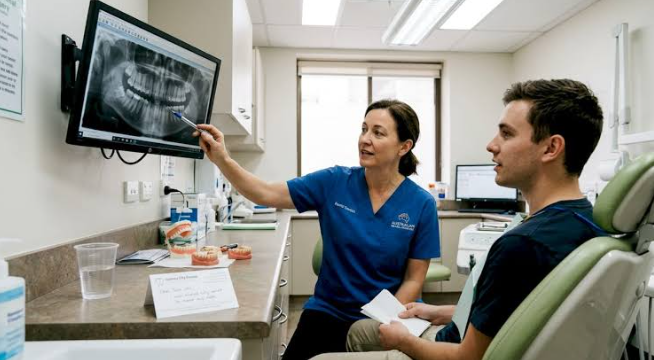
Dental professionals typically begin with a panoramic X-ray to map the position, angle, and depth of each wisdom tooth relative to nerves and adjacent teeth. This imaging step determines whether a tooth can be removed with a straightforward extraction or whether it requires a surgical approach involving an incision in the gum tissue. Age plays a role in this assessment as well, since the roots of wisdom teeth in younger patients are often less developed and easier to remove with fewer complications. A thorough evaluation also considers the patient’s overall health history, since certain medications or conditions can affect healing and sedation choices. Some providers also use three-dimensional imaging for cases where a tooth sits unusually close to a nerve, giving the surgeon a clearer picture before the first incision is made.
Once the evaluation is complete, the provider discusses sedation options ranging from local anesthesia to intravenous sedation, depending on the complexity of the case and the patient’s comfort level. Recovery instructions usually cover diet restrictions, ice application, and signs of complications such as dry socket or prolonged bleeding. Most patients return to normal activity within a few days, though full healing of the extraction site can take several weeks to complete. Clear communication before and after the procedure reduces confusion during recovery, which is one reason providers spend extra time walking patients through what to expect. Follow-up appointments give the surgical team a chance to check healing progress and address any lingering swelling or discomfort before it becomes a larger concern.
See also: When to Increase Tirzepatide: The Four-Week Minimum and Tolerability Decision
What to Look For
Patients researching options often start by comparing credentials, sedation capabilities, and patient reviews before scheduling a consultation. Location and scheduling flexibility matter too, particularly for patients who need same-week appointments because of pain or swelling that has already started interfering with daily routines. Houston residents evaluating wisdom teeth removal providers Houston frequently find that providers offering in-house imaging and sedation cut down on the number of separate appointments needed before surgery. A provider who explains the procedure clearly and answers questions without rushing tends to leave patients feeling more prepared for what comes next. Word of mouth from friends or family who have already gone through the procedure often carries as much weight as online reviews, particularly when it comes to judging bedside manner and post-operative support.
Verifying credentials and looking for transparent pricing before committing to treatment also helps patients avoid unexpected costs after the fact. Independent resources such as ADA oral health resources offer general guidance on what to ask a provider and how to interpret imaging results, which can serve as useful reading before a consultation. Reading patient testimonials alongside these broader guidelines tends to give a fuller picture than either source provides on its own. A provider’s specific track record combined with general dental health education tends to produce better-informed decisions before the day of surgery arrives. Patients who take the time to ask about anesthesia protocols, emergency contact procedures, and expected recovery timelines usually walk into the appointment with fewer surprises waiting for them afterward.
